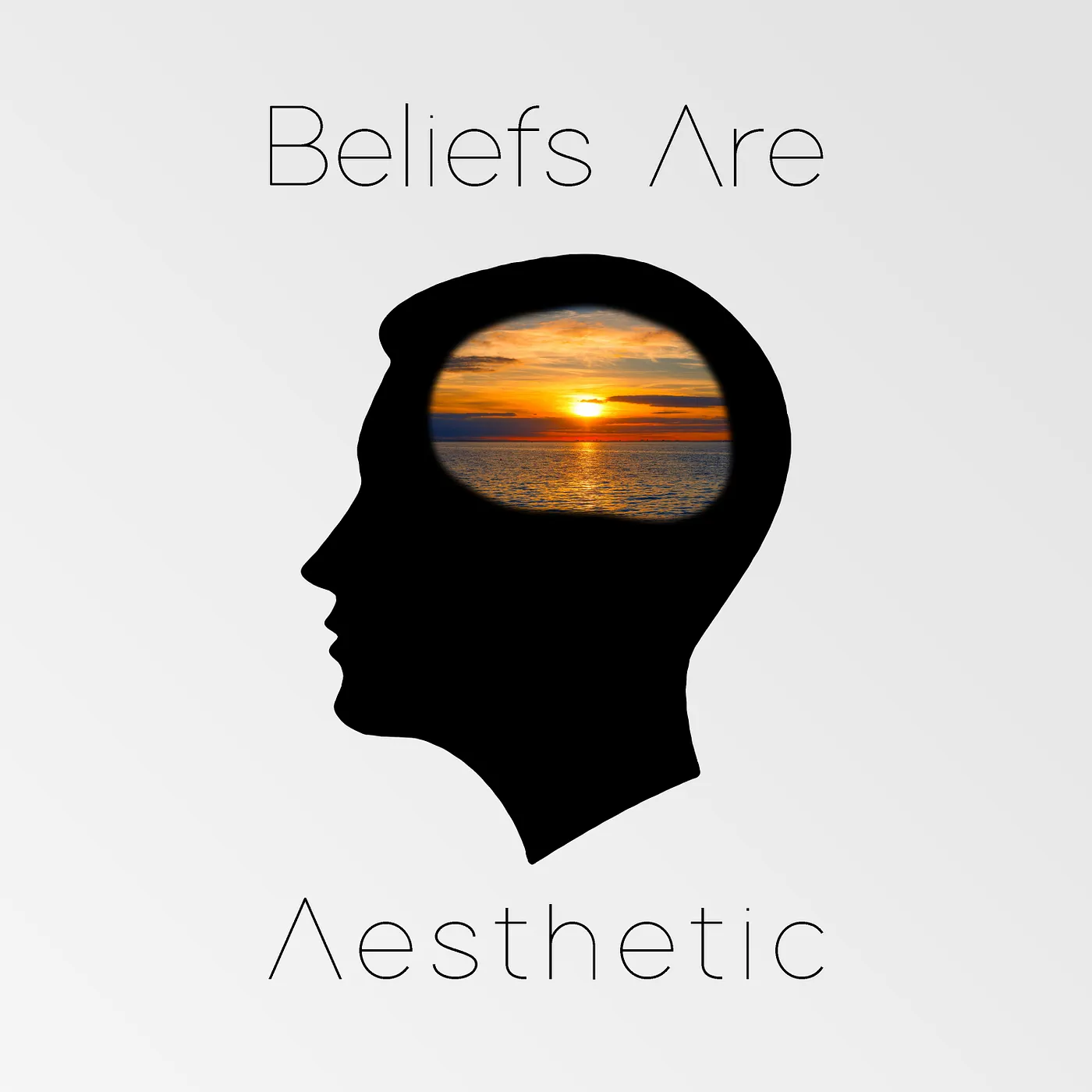
Why do people believe what they believe?
It's generally accepted that people arrive at their beliefs based on emotion, not logic. But what exactly is the processing that's occurring, which leads them away from some beliefs and toward others?
Certainly the most obvious answer, that people simply feel good when they are part of a mob and bad when they stand alone, is partially correct and this gradient by itself is enough to push some people into the same beliefs as their tribe. But some people hold beliefs that are not in perfect alignment with their social surroundings. What's happening here?
Other people claim to arrive at their beliefs via reason. It seems unlikely that all of them are lying or entirely mistaken about what's happening in their own minds. Are they genuinely ratiocinating?
The theory that I'm going to present in this essay will answer these questions. The first step is to understand that the nature of the way the brain functions is fundamentally metaphorical. That is, it uses symbolic stand-ins for concepts and experiences. This is because its processing capacity, and the capacity of short-term memory in particular, is highly limited compared to the vastness of reality. Metaphors are information compression, and they extend the reach of the brain's capacity just as compression algorithms do for silicon computers.
These metaphorical stand-ins are typically imagistic — a still frame of a remembered scene if possible, but otherwise imagined. The images then typically imply scenes which also include other senses, all of which is tied to certain emotions. It's on these emotions which the images conjure that the reasoning occurs. For example, if a person needs to reason about a relationship they once had, it would be impossible to hold the entirety of the many experiences that comprised that relationship in their head at once. Instead, one or possibly a few images, probably taken from their memories of some of the most significant of those experiences, are used to represent it. Their emotions are triggered by these representations, and a conclusion is reached accordingly.
Once a metaphor image is established for a particular concept, it tends to remain unchanged, at least unless a change is strongly called for. Thus, if a particular angle on the concept is indicated by the context of the reasoning, it will influence the images that are chosen, and subsequently the reasoning that is conducted with them. For example, if the person is asked if the fights in that relationship outweighed the good times, this will prompt them to use images from those fights as representations of the relationship. Those images will include in their "metadata" the other senses in the scene they were taken from, and together these will invoke emotions — probably largely negative in this case. They might then conclude that, compared to representative images of the good times, the fights were worse. On the other hand, if they had simply been asked if the relationship was a net positive in their life, they might not have chosen images from the fights at all, and consequently, upon evaluating the emotional valence all of the images that were chosen, concluded that it was in fact a net positive. This is the nature of the psychological phenomenon of framing.
When reasoning about the future or any counterfactual possible realities, there are often no adequate memories to draw a metaphor image from, and so a hypothetical must be imagined. For example, a person deciding whether they'd like to go to the movies will imagine being at the movies, perhaps sitting in an armchair in the dark with a cup full of popcorn as the THX logo plays. Once one particular image is settled on as the defining representation, if it conjures good emotions, the person will conclude that, in fact, they would like to go. The process is therefore experimental in nature; the mind runs a "trial" of what the experience of making the decision will be like. This is essentially how all decisions are made.
People can arrive at different conclusions about the same thing because they derive different emotions from the same set of experiences, or because they weight those emotions differently. But perhaps the most common reason is that they simply use different metaphor images to represent the same thing. Whereas one person might represent the moviegoing experience with an image of sitting comfortably in the theater with their popcorn in hand, another might use an image of waiting in a long line on a sticky tile floor in a poorly smelling lobby. While the totality of the experience they would ultimately have might include both, they will likely arrive at different conclusions about whether they want to go.
The exact same process is employed when a person evaluates whether they'd like to adopt a belief: they conjure an image to represent what it would feel like to hold that belief.
This is made more powerful in the specific case of beliefs by the unique role they play in shaping our experience. The standard way of understanding beliefs is that they are arrived at through a bottom-up process of collecting data and then drawing conclusions. And this is partly true. But the causal flow of our cognition is not bottom-up linear. It goes both ways. Our perceptions inform our beliefs, but our beliefs also inform our perceptions. This is for the same reason as we use metaphors: the world is simply too vast and complex for our limited minds to process all of it. Filtering must occur before most stages of processing, and thus criteria for filtering must exist. This is one of the roles played by belief. Thus, we cannot think or perceive without the structure provided by belief.
Because the beliefs we hold fundamentally alter our experience of the world, every belief has a built-in aesthetic quality to it, which is specific to us, and which is largely separate from its moral or intellectual content. This aesthetic quality exists in the flavor of the skew it adds to the holder's perceptions, emotions, and thoughts. Every belief changes the way the world feels. No one ever talks about this.
When a person is determining whether they'd like to adopt a belief, then, they use their image metaphor for it to "try it on". They look through its lens and see how it makes the world feel, how it makes them feel, etc. Everyone has aesthetic preferences for how they want these things to feel. They choose the beliefs that give them those feelings. This is the primary basis on which beliefs are chosen.
Take libertarianism as an example. My guess is that for most libertarians, holding their belief system makes them feel badass, dangerous, heroic. Their image metaphor might be something like standing on a mountaintop overlooking a vast wilderness, the wind blowing in their hair, their shirt in tatters after having wrestled a wolf with their bare hands, their muscular body showing through from underneath; they are reliant on no one, and any institution that would seek to influence them manifests as a looming shadow monolith imposed into the pristine wilderness landscape before them. Perhaps it's not exactly this, but the emotional result is likely similar. The type of people who are attracted to this experience of the world are the type of people who become libertarians.
This is why belief systems so often come with fashion accoutrements. Punk rock is ostensibly about rebellion against the establishment, but also has a signature haircut. Conventionally, one might be tempted to say the philosophy comes first and then informs the haircut. But perhaps more accurately, the haircut is what's chosen, and it informs the philosophy.
Perhaps the most salient component of how beliefs are aesthetically evaluated is in how other people's perception of the holder will make them feel. A punk rocker likes getting stares when they walk through a shopping mall with their 2-foot mohawk. If they're looking for this reaction, because perhaps they feel ignored in other areas of life, this might be the deciding factor when they try on punk rock's image metaphor.
Therefore, often the ontological component that comes with a belief is a side effect, baggage, dead weight. But it has to come with in order to justify the aesthetics, especially socially. This is part of why hypocrisy is so common and cognitive dissonance is so uncommon — most beliefs are not held deeply on profound philosophical grounds.
Why people are attracted to some aesthetics and repulsed by others is undoubtedly in large part simply genetics. But the aesthetics of the belief systems they were raised into are also important. When a person grows up with a certain feeling toward the world, toward themselves, toward other people, they fall in love with that, they structure their entire being around it. To try and adopt a different way of seeing represents a vast challenge, not just because they will have to make different decisions based on different sets of facts or heuristics, but because they will feel different — and crucially wrong, dirty — every moment of every day until they become accustomed to it.
It's easy to see, then, why bad beliefs are often more repulsive than good beliefs are attractive, and why people are so highly motivated to expunge bad beliefs from others. To try to understand another's belief system means to try it on with image metaphor, which means to let its aesthetic quality temporarily invade one's entire being, to let something gross inside of oneself. This is a massive barrier against empathy. The disgust response is powerful. Having tried this, even briefly in private, can leave one with a lingering feeling of having been tainted. It is this feeling that people are trying to extinguish via projection when they act out against the holders of those bad beliefs.
All of this prescribes a certain style of argumentation that I've never really seen anybody engage in — to try and sell someone on a belief by presenting a seductive metaphor image for it. If you want to convince someone of a belief system, don't explain the epistemological merits, but paint a picture of how it feels to hold it, specifically tailored to whatever you think their aesthetic preferences are. If they have a strong tendency toward contrarianism, paint of a picture of heroic rebellion, etc.
This also represents an avenue of falsifiability for this thesis. If arguing on the basis of the aesthetic attractiveness of the metaphor images of belief systems does not have a higher conversion rate than other methods of argumentation, it is likely false.
I won't do this. I'll continue to argue on the basis of logic and reason.
But for most, it's aesthetics all the way down. People don't have haircuts; haircuts have people.